
Responsible gambling begins before a session starts, not after a loss has become difficult to manage. For adults considering play sweet bonanza live, the most useful approach is to understand which controls belong to the game and which are managed by the casino account. This distinction matters because stake settings, autoplay options and game history may sit inside the slot, while deposit limits, cooling-off periods and self-exclusion are normally controlled by the operator. A clear plan can make play easier to monitor and stop.

Separate game controls from account protections
The slot interface can provide several immediate ways to manage a session. Players may be able to choose the stake, review the rules, inspect the applicable RTP and access game history. Depending on the casino’s version, Quick Spin and Autoplay may also appear. These controls can make the experience more convenient, but convenience is not the same as protection. A faster sequence of spins can make it harder to notice how long a session has lasted or how much has been spent.
Account-level safeguards are broader and usually more important for long-term control. Deposit limits, loss limits, session reminders, cooling-off periods and self-exclusion are handled by the casino rather than by the slot provider. Their names, settings and availability can vary according to the operator and the rules applying in the player’s province. Before playing, locate these tools in the account area or responsible-gambling section and read how quickly each setting takes effect.
It is also useful to understand what the game cannot do. The slot does not manage deposits, withdrawals, identity checks or account recovery, and it cannot independently impose a personal budget across different games. If you want a limit that covers all casino activity, an operator-level control is more suitable than a setting inside one game. For broader Canadian information about gambling risks and support, consult Canada’s Responsible Gambling information.
Build a budget before opening a session
A gambling budget should come from money available for entertainment after essential costs, savings and financial commitments have been covered. It should not be based on expected winnings, a previous loss or the hope that a bonus will stretch funds further. Decide both a maximum amount and a time window before starting. A weekly or monthly limit can prevent several small sessions from quietly becoming a much larger expense.
Keep the budget separate from everyday spending wherever practical. Using a dedicated account balance or a clearly defined entertainment amount makes the boundary easier to see. Avoid borrowing, using credit intended for bills or increasing the budget during play. If a deposit limit is available, set it before the first deposit rather than waiting until the session becomes emotional. Check whether the operator measures the limit by day, week or month, since these definitions can differ.
Promotional funds need their own calculation. A welcome offer may include wagering requirements, expiry dates, maximum-bet rules or restrictions on how free spins contribute to a promotion. These conditions are created by the casino, not by the game’s built-in features. Treat bonus funds as conditional, not as cash value, and confirm the stated requirements before accepting an offer. If the terms are unclear, contact the operator before making a deposit.
Use stop points instead of chasing outcomes
Random results do not become more likely to change because a player has lost several spins. A losing sequence does not create an obligation for the next spin to compensate for it, and a recent win does not make another win due. Setting stop points in advance helps separate decisions from the excitement of the moment. Useful points may include reaching the session budget, reaching a time limit or experiencing a predetermined loss.
Autoplay can be approached cautiously. If the casino version provides stop conditions, review them before enabling the feature. Possible conditions may include stopping after a selected number of rounds, after a win or feature, or when the balance changes by a chosen amount. These options can support a plan, but they do not guarantee that the plan will be suitable or that play will stop at the exact personal limit intended.
Take a short break before deciding whether to continue. During the break, check the account history and compare the result with the original budget rather than judging the session by its most exciting moment. Do not raise the stake to recover money or keep playing solely because a feature seems overdue. If stopping feels difficult, disable autoplay, leave the game and use a cooling-off or self-exclusion tool instead of relying on willpower alone.
Check the version and promotion before playing
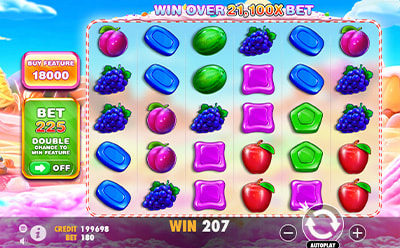
Responsible decisions depend on accurate information. The original game uses a 6×5 grid, a Tumble mechanic and wins based on matching symbols anywhere on the grid. Its built-in Free Spins feature is different from promotional free spins supplied by a casino. The game’s own feature begins when the required Scatter symbols land, while promotional spins are governed by separate casino terms and may carry conditions on wagering, expiry or maximum bets.
Do not assume that every version has identical settings. Operators can offer different RTP configurations, stake ranges and feature availability. The in-game information screen should show the rules and RTP for the version actually loaded. Options such as Ante Bet or Bonus Buy may be unavailable in some accounts or jurisdictions. A higher-cost feature or increased stake does not improve the certainty of a result; it only changes the amount being risked.
Read the promotion’s full terms before treating it as part of a budget. Check whether the offer requires a minimum deposit, restricts eligible games, limits the maximum stake or sets a deadline. Also confirm how withdrawals are affected while wagering conditions remain outstanding. If the offer encourages a larger deposit than planned, declining it may be the safer choice. A promotion should fit an existing entertainment budget, not determine the size of that budget.
Know when ordinary controls are not enough
Warning signs can appear even when the amounts involved seem manageable. Playing longer than intended, hiding sessions, thinking about gambling throughout the day, borrowing to continue or feeling pressure to win back losses are reasons to pause. Irritability after stopping, neglecting responsibilities and repeatedly changing limits can also indicate that normal session controls are no longer sufficient.
When these signs appear, use stronger barriers. A cooling-off period can create immediate distance, while self-exclusion can prevent access for a longer selected period where the operator offers that option. Remove saved payment details if possible, avoid promotional messages and tell a trusted person what action you are taking. Do not treat a limit increase as a solution to a limit that has already been reached.
Support can help before a situation becomes a crisis. Contact the casino’s responsible-gambling team for information about available account restrictions, but do not assume the operator can provide counselling or manage gambling across every website. A health professional or recognised gambling-support service can help assess the pattern and suggest next steps. If gambling is connected with immediate financial danger or thoughts of self-harm, seek urgent local assistance rather than continuing to play.
Questions about safer play with Sweet Bonanza
Are the game’s Free Spins the same as a casino free-spin promotion?
No. The built-in feature is triggered by Scatter symbols during play and follows the game’s own rules. Promotional free spins are supplied by the casino and may have wagering, expiry, game-eligibility and maximum-bet conditions. Check the promotion terms separately before accepting or valuing the offer.
Can the slot set a personal loss or deposit limit?
Usually, those protections are account-level tools managed by the casino. The game may offer stake selection, autoplay conditions and game history, but deposit, loss, cooling-off and self-exclusion settings depend on the operator. Review the casino’s responsible-gambling area for the controls available to your account.
What should I do if I keep chasing losses?
Stop the session and avoid making another deposit to recover the loss. Disable autoplay, apply a cooling-off period or request self-exclusion, and speak with a qualified support service or health professional. Telling someone you trust can add practical accountability while stronger controls take effect.